
Research overview
Deathbed Visions & Visitations
A scientific examination of one of the most profound and consistently reported phenomena at the end of life
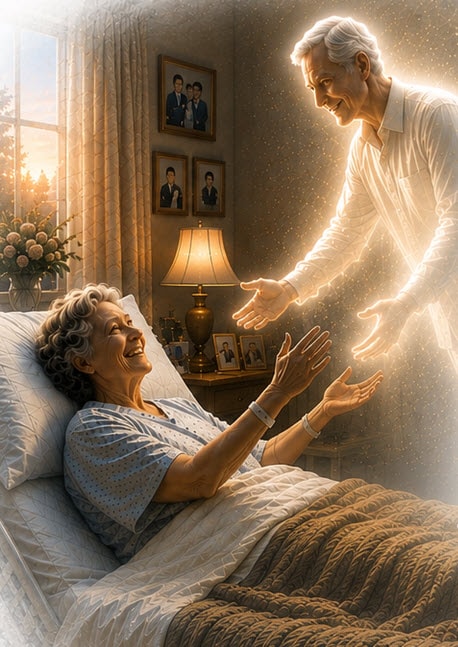
What Is a Deathbed Vision?
When a terminal hospice patient reaches toward the ceiling, says they are talking to deceased family members or friends, and seems to be comforted by the visitation they are experiencing, this is known as a Deathbed Vision/Visitation (DBV).
People are more familiar with Near-Death Experiences, yet the DBV phenomenon puts us center stage with our very own deceased family members. These are not hallucinations — ask any experienced hospice nurse or death doula, as those angels (caregivers) on earth experience this frequently.
Listen to the rhythm and cadence of the patient's conversation with the otherwise invisible visiting spirit. Because the spirits communicate with the patient via telepathy, you will hear only half of that conversation, not unlike listening to someone wearing earbuds during an active phone call.
The research process joins that same dialogue in a sensitive, respectful, ethical, and legal way as one part of our scientific — not anecdotal — research into life after death.
The Research Framework
The research will be in full compliance with 45 CFR 46 and the Belmont Report and will utilize, as required, an Institutional Review Board (IRB).
An IRB is an ethics committee of five experienced and diverse professionals that convenes to review the planned involvement of volunteer patients and the related documentation and procedures. As required by law, it ultimately approves or disapproves research projects involving human subjects.
A foundational case
The Story That Helped Shape the Scientific Method
This Deathbed Vision story became my second discovery and was important to developing my scientific methods.
Don Merdith, from Duffield, Alberta, tells a story in a video about his wife and his ninety-year-old mother in extended care. Don's wife had been stressed out while renewing her passport because she could not recall where her mother was born, a piece of information that was required on the form. Since she knew her mother's family was from Quebec, she put that down on the form. She did not have confidence in that place of birth.
It bothered her, and she prayed over it because she was worried the error would be identified and impact her passport renewal. A few weeks later, Don, his wife, and their daughter flew to Texas to visit Don's mother, who was terminally ill. Instead of her normal joy in seeing them, his mother asked if they had seen her relatives who had "just left." They explained they had not seen them. The conversation, which included his mother using the names of the relatives, informed Don that they were all deceased family who had just left her room. Don replied that they humored her, but it was obvious she was quite shaken by the experience.
A few days later, the visit was ending as Don, his wife, and their daughter had a flight home that afternoon. His mother understood and wished them a safe flight home.
As they were walking out, Don's mother shouted out to her daughter-in-law, saying, "They said to tell you that your mother was born in Saskatchewan."
While driving to the airport, Don's wife said, "You know she's right? Mom was born in Saskatchewan."
"How did she know that?" their daughter asked.
They didn't know — because they had never told her that and they had not discussed the passport concern at all.
Don Merdith, 2014. Transcript for Deathbed Visitation — Message from the Other-Side — Ndeaccounts. https://youtu.be/Iox5ZQNsaxE
Have a Deathbed Vision Story to Share?
If you or someone you know has witnessed a Deathbed Vision, your account may contribute to this ongoing scientific research.
Submit Your Story